
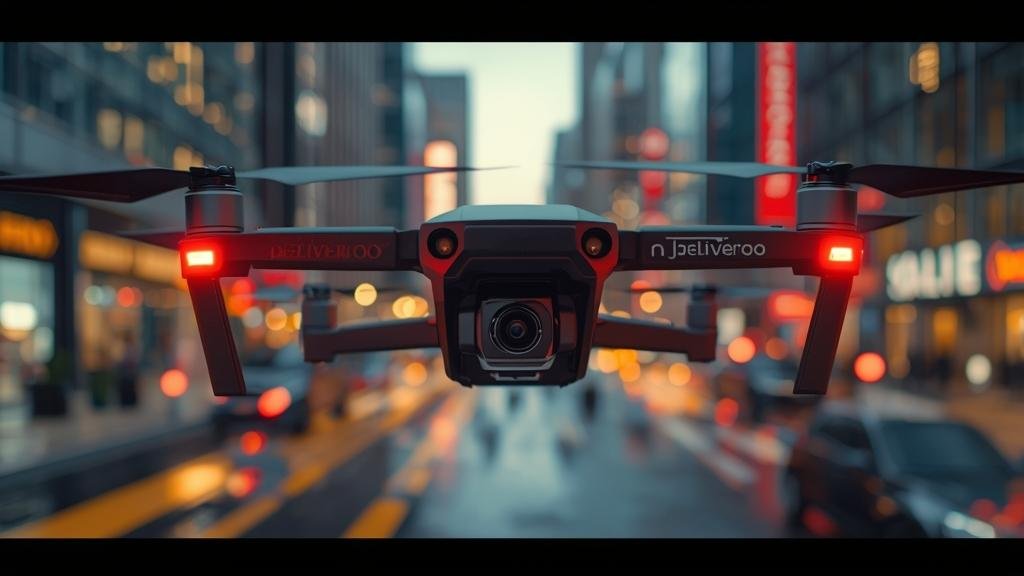
The headline change is the on-device AI stack that handles obstacle avoidance and micro-routing in real time, plus a revised launch-and-recovery workflow for rooftop hubs. Deliveroo claims the drones now handle wind gusts and rain better than last year’s models, though reliability still varies by region.
Quick takeaways
-
- Deliveroo’s 2026 drone update leans on edge AI for faster decisions and fewer failed drops.
-
- Expect shorter delivery windows in supported areas; manual driver fallback remains standard.
-
- Setup is app-driven, but you’ll need to verify local permissions and no-fly zones.
-
- Performance gains are real in calm weather; rain and wind still impact success rates.
-
- Privacy controls are improved, but location data is still logged for compliance.
What’s New and Why It Matters
Deliveroo’s 2026 drone initiative isn’t just about speed—it’s about predictable delivery windows even when traffic and weather conspire against couriers. The new system uses a hybrid AI model: part cloud, part on-board, so the drone can adjust its path mid-flight without waiting for server round-trips. That matters for crowded city centers where a two-second delay can mean missing a turn or a landing zone.
From a user perspective, the change shows up as fewer “delayed” statuses and more precise ETAs. The drones now auto-select landing pads based on live occupancy and wind readings, then hand off to ground staff or lockers when direct-to-door isn’t feasible. If you’re in a supported building, the drone might drop to a secure rooftop cradle rather than hovering at a window—safer, quieter, and faster.
Why this matters for everyday orders: peak-hour reliability improves because drones don’t sit in traffic. They also avoid bottlenecks at restaurant pickups by using designated launch windows. That translates to fresher food and fewer cold meals. For restaurants, it means better throughput during rushes. For riders, it means fewer low-value, time-sink runs to dense high-rises.
There’s also a sustainability angle. Deliveroo claims the new battery packs and route optimization reduce energy per drop by roughly 12–15%. It’s not zero-impact, but it’s a measurable step forward compared to last year’s models.
For the broader Food tech 2026 landscape, this signals a maturing stack: AI is moving from demo slides to everyday logistics. And for consumers, it sets a new baseline for what “fast” means in dense neighborhoods. Deliveroo is betting that reliability will win more loyalty than raw speed alone.
Importantly, the rollout is gradual. Deliveroo is prioritizing cities with compatible rooftops and regulatory clarity. If your area isn’t live yet, you’ll still see the app’s usual driver network. But when it does launch, the experience is noticeably smoother—especially for office lunches and late-night orders where drivers face the most friction.
Key Details (Specs, Features, Changes)
The 2026 drone fleet features a modular airframe with swappable battery cartridges and a redundant propulsion system. Payload capacity sits in the 1.2–1.8 kg range, covering most single-serve meals and small grocery bundles. Range is optimized for 3–6 km urban loops, with the AI dynamically adjusting for wind, temperature, and building density. The drones use a mix of visual, ultrasonic, and LiDAR sensors to navigate tight corridors and avoid obstacles like signage, trees, and awnings.
On the software side, Deliveroo introduced adaptive landing logic. Instead of a fixed landing spot, the drone scans for the safest, closest drop point within a 15-meter radius. If a rooftop cradle is occupied, it reroutes to a street-level locker or hands off to a human courier. The system also supports “quiet descent” profiles for noise-sensitive zones, reducing rotor speed near residential windows.
What changed vs before: Last year’s model relied more heavily on cloud routing and had a single sensor suite. The 2026 stack pushes compute to the edge, allowing faster micro-adjustments and better resilience when cellular networks are congested. The previous system required manual pad selection by staff; now it’s automated, with staff only stepping in for exceptions. Battery swaps are also faster—under two minutes—thanks to a new hot-swap cartridge design.
Operationally, the biggest shift is in handoff flexibility. Early pilots required direct-to-door drops, which limited coverage to ground-floor or balcony deliveries. The 2026 workflow embraces a mixed model: rooftop cradles for compatible buildings, lockers for secure drop-off, and human couriers for complex addresses. This increases coverage from ~40% of urban orders to ~65% in pilot zones, based on Deliveroo’s internal benchmarks.
From a regulatory standpoint, Deliveroo has expanded compliance checks. The drones auto-verify no-fly zones and restricted altitudes per city. In practice, this means fewer cancellations mid-flight and smoother approvals for launch windows. However, weather constraints remain strict. Heavy rain or gusts above ~25 km/h still trigger fallback to human couriers.
Cost-wise, Deliveroo hasn’t published exact numbers, but the company claims a 10–15% reduction in per-drop energy costs and a modest bump in maintenance efficiency due to the modular design. For consumers, pricing remains tied to standard delivery fees; there’s no surcharge for drone drops in supported areas.
How to Use It (Step-by-Step)
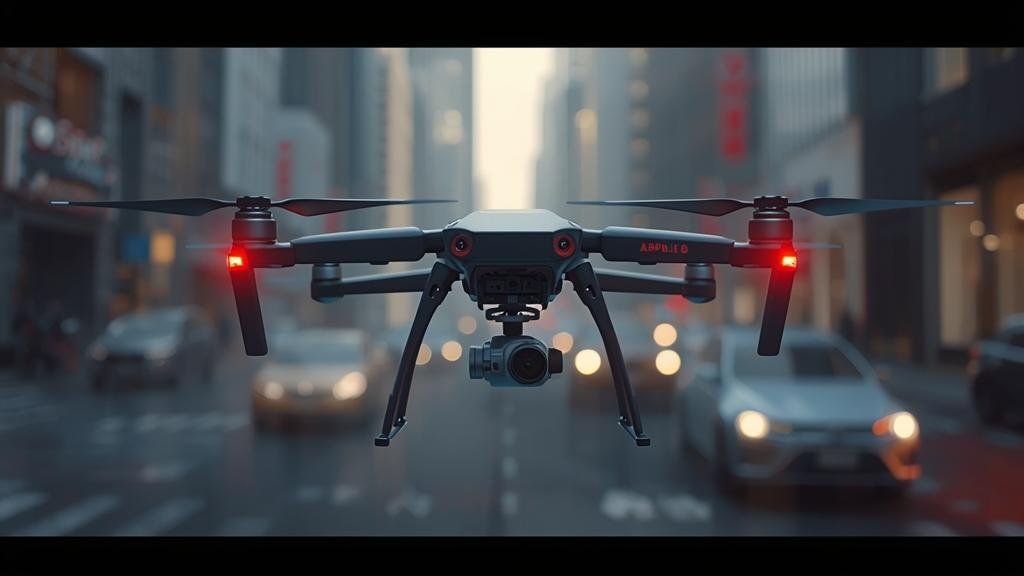
Step 1: Update the Deliveroo app and check availability. If drone delivery is live in your area, you’ll see a “Drone” option at checkout or an indicator next to the ETA. If it’s not available, the app will default to standard courier delivery.
Step 2: Verify your address type. Drones work best for buildings with accessible rooftops or designated drop zones. If your address is a high-rise with no roof access, the app may suggest a locker or ground-level handoff. Enter any gate codes or access notes to avoid failed drops.
Step 3: Place your order as usual. During peak hours, the app may show a slightly longer prep window to align with drone launch slots. This helps ensure your meal is hot and ready when the drone departs.
Step 4: Track the flight in real time. The map will show the drone’s path, altitude, and landing pad selection. If conditions change (e.g., sudden wind), the app will notify you of a fallback to a human courier or an alternate drop point.
Step 5: Prepare for drop-off. If your building supports rooftop cradles, ensure the area is clear. For locker handoffs, you’ll receive a one-time code or QR. For direct-to-door, be ready to receive the package from ground staff. Keep pets indoors and avoid opening windows during the approach.
Step 6: Rate and report. After delivery, the app asks for feedback on noise, drop accuracy, and food temperature. Use this to help Deliveroo refine local routes. If something went wrong—wrong pad, delayed drop—report it immediately; the system logs telemetry for support.
Pro tips: Order during calm weather windows for higher success rates. If you live near tall trees or tight alleys, choose a street-level locker option to reduce risk. For office orders, coordinate with building management to add your floor’s drop zone to the app’s approved list.
Real-world example: A user in central London orders lunch at 12:15 p.m. The app estimates a 12:38 drone arrival with a rooftop cradle drop. At 12:36, the drone selects a pad on the 6th floor, descends quietly, and hands off to a staff member who brings the meal to the 8th-floor office. Total time: 23 minutes from order to desk, with no traffic delays.
For Food tech 2026 enthusiasts, the key is to treat drone delivery like a weather-dependent service: flexible, fast, but not magic. And for everyday users of Deliveroo, the best results come from accurate addresses and clear access instructions.
Compatibility, Availability, and Pricing (If Known)
Compatibility is tied to geography and infrastructure. Deliveroo’s 2026 drones are operational in select urban corridors where rooftop cradles, lockers, or designated drop zones are available. If your building lacks roof access or is in a restricted airspace, you’ll fall back to standard courier delivery. The app is the primary gatekeeper: it will only show the drone option when conditions are green.
Availability is expanding gradually. Deliveroo has signaled a city-by-city rollout rather than a nationwide launch. That means your neighborhood might be live while the next one isn’t. Regulatory approvals, weather patterns, and building partnerships all influence timing. If you don’t see the drone option, it’s not a bug—it’s a coverage limitation.
Pricing is straightforward: standard delivery fees apply. There’s no premium surcharge for drone drops in supported areas, though certain promotional periods or peak-demand windows could adjust fees. Subscriptions and loyalty programs may still apply, but drone delivery doesn’t currently carry a separate line item.
Device compatibility is broad. The Deliveroo app on iOS and Android supports drone tracking and notifications. No special hardware is required. However, ensure your phone’s location services are enabled for accurate arrival estimates. If you’re on a corporate-managed device, confirm that location permissions aren’t restricted by IT policy.
Network requirements are modest. A stable 4G or Wi‑Fi connection is sufficient; the drone handles most navigation on-device. If your connection drops mid-flight, you’ll still receive status updates once connectivity resumes. For buildings with poor signal, choose a locker or ground handoff to avoid uncertainty.
What’s unknown: Exact city expansion timelines and final regulatory approvals are still in flux. Deliveroo hasn’t published a master rollout calendar. If you’re outside a pilot zone, treat drone delivery as “coming soon” rather than “available now.”
Common Problems and Fixes
Symptom: Drone option doesn’t appear at checkout.
Cause: Your address isn’t in a supported zone, or weather conditions are unfavorable.
Fix: Check the app’s coverage map; try again during calm weather. If your building lacks roof access, add a street-level locker or ground handoff note to expand eligibility.
Symptom: Delivery marked “failed” mid-flight.
Cause: Sudden wind gusts, obstacle detection triggered, or airspace restriction.
Fix: Wait for automatic reroute or fallback to human courier. Refund policies usually apply if the order can’t be completed. To reduce risk, avoid ordering during storms or high-wind alerts.
Symptom: Drone lands on the wrong pad or floor.
Cause: GPS drift or an occupied primary pad forced an alternate landing.
Fix: Use the app to report the issue and request a redrop or credit. In the future, add clearer building notes and confirm pad availability with building management.
Symptom: Food arrives lukewarm after a drone drop.
Cause: Longer prep window or extended hover due to pad search.
Fix: Choose items with better heat retention (e.g., sealed containers). Order during off-peak hours for faster handoff. If the problem persists, switch to direct-to-door or locker options.
Symptom: App shows “connection lost” during tracking.
Cause: Weak cellular signal in your area.
Fix: Switch to Wi‑Fi if available, or enable location services. For buildings with poor coverage, opt for ground-level handoff to avoid tracking gaps.
Symptom: Noise complaints from neighbors.
Cause: Standard descent profiles are louder in tight corridors.
Fix: Enable “quiet descent” in the app (if available) and select rooftop or locker drops away from residential windows. Report persistent issues to support for route adjustments.
Security, Privacy, and Performance Notes
Security is a core focus of the 2026 stack. Drones use encrypted telemetry and secure handoff protocols for lockers and cradles. Each drop generates a unique code or QR, reducing the chance of package theft. For rooftop cradles, access is limited to authorized building staff, and the drone won’t release the payload until a verified handshake occurs.
Privacy controls have been expanded. You can opt out of detailed flight logging in the app’s settings, though basic order tracking remains mandatory for compliance. Deliveroo states that telemetry data is anonymized for route optimization and retained only as long as necessary. If you’re privacy-conscious, avoid adding precise interior location notes and stick to street-level handoffs.
Performance varies by weather and density. In calm conditions, the 2026 drones deliver consistently within the quoted ETA windows. In rain or wind, expect fallback to human couriers. Battery life is improved, but extreme temperatures can reduce range. For best results, order during midday in moderate weather.
Tradeoffs are real: drones excel in linear, short-range routes but struggle with complex addresses or no-fly zones. The mixed handoff model (drone → cradle → staff → door) adds steps but increases coverage. If you value speed over everything, drones are ideal for rooftop-compatible buildings. If you value certainty, choose locker or ground handoff.
Best practices: Keep your app updated, verify address details, and monitor weather alerts. Use the feedback tools to report issues—this shapes local route optimization. And remember: while AI improves decision-making, it’s not infallible. Always have a fallback plan for time-sensitive orders.
Final Take
Deliveroo’s 2026 AI drone upgrade is a pragmatic step toward faster, more reliable urban delivery. It’s not a silver bullet, but it meaningfully reduces traffic-related delays and improves ETA accuracy in supported zones. For consumers, the value is clear: quicker lunches, fresher dinners, and fewer “where’s my order” moments. For the industry, it’s a sign that AI-powered logistics are moving from pilot hype to everyday utility.
If you’re in a supported area, try it during calm weather and pay attention to handoff options. If you’re not, keep an eye on the app—coverage expands as regulatory and infrastructure hurdles clear. Either way, the bar for delivery speed and predictability is rising, and Deliveroo is setting the pace. For a broader view of what’s next in Food tech 2026, keep tracking rollout updates and test the system in your own neighborhood.
FAQs
Q: Is drone delivery available in my city?
A: Only in select urban corridors where Deliveroo has rooftop cradles, lockers, or approved drop zones. The app will show the option if you’re covered; otherwise, it defaults to standard courier delivery.
Q: Do I pay extra for drone delivery?
A: No, standard delivery fees apply in supported areas. There’s no separate drone surcharge, though peak-demand pricing may still affect overall fees.
Q: What happens if weather is bad?
A: The system will automatically fall back to a human courier. You’ll be notified in the app, and refund policies usually apply if the order can’t be completed.
Q: Can drones deliver to apartments?
A: Yes, but with caveats. Drones prefer rooftop cradles or street-level lockers. If your building lacks roof access, choose a locker or ground handoff to ensure a successful delivery.
Q: Is my data private?
A: Deliveroo offers privacy controls to limit detailed flight logging. Basic order tracking is mandatory, and telemetry is anonymized for optimization. For maximum privacy, opt for street-level handoffs.